


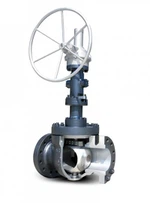


Floating Ball Valve
Side-entry floating ball valves are manufactured in accordance with API 6D. The valve is configured in a forged bolted two-piece split-body design with a small diameter, suitable for medium/low pressure working conditions. Characterized by simple design, the valve seats are directly inserted into the body.
The upstream flow pressure pushes the free-floating ball against the downstream seat-the resulting compression provides a perfect leak-free sealing solution.
The stem is connected at the top of the ball and allowing the valve to open and close with a quarter-turn movement.
Material selection is fully customizable to meet the customer's project specifications and several unique features are available offering an enhanced technical solution suitable for aggressive offshore environment and corrosive and abrasive fluids.
VALVE DESIGN
Based on API 6D
TEMPERATURE RANGE
-150 to 662°F (-101 to 350°C)
SIZE
NPS 1/2-6 (DN 15-150)
PRESSURE RATING
ASME 150 - ASME 2500
FACE-TO-FACE
As per API 6D standard
END CONNECTIONS
RF, RTJ as per B16.5 &B16.47
SW, Socket Welded as per B16.11
BODY DESIGN
Forged/casting bolted two-piece
SEAT DESIGN
Soft or metal seated with Hardfacing on ball and seats
FEATURES
Secondary seals in pure Graphite
Anti-Static Device
Anti Blow out stem
Bi-directional tight shut-off
Low fugitive emission stem packing available
O-ring /Lip seals and Graphite configuration
OPERATOR
Manual: wrench or Gear with padlocking
TESTING & CERTIFICATIONS
Compliance with API 6D & ISO 5208 & API 598 inspection and testing
Fire safe and fire tested as per API 6FA/ 607
SIL 3 Certification as per IEC61508
Fugitive Emission as per ISO15848
PED 2014/68/UE
How is the sealing structure of a floating ball valve designed?
The sealing structure design of floating ball valves usually focuses on ensuring that the valve can effectively prevent medium leakage in the closed state. The following is a detailed description of its sealing structure design:
Double bevel elastic sealing ring or V-groove elastic sealing ring:
Floating ball valves often use double bevel elastic sealing rings or V-groove elastic sealing ring structures.
This design provides a stable sealing effect without significant loss of sealing performance as the number of operations increases.
Contact design between valve seat and ball:
The valve seat is usually designed with multiple sealing surfaces that closely fit the surface of the ball.
When the ball rotates to the closed position, the sealing surface on the ball is in complete contact with the sealing surface on the valve seat, forming one or more sealing lines.
The material selection (such as stainless steel, carbide, etc.) and surface treatment (such as polishing, grinding, etc.) of the sealing surface are crucial to the sealing performance.
Stuffing box and gland design:
For ultra-low temperature floating ball valves, in order to ensure that the stuffing box and pressure sleeve are used at normal temperatures and avoid frostbite to operators and reduction in packing sealing performance, an extended valve stem design is usually adopted.
A drip plate design is used on the extended valve stem structure to prevent condensed water from vaporizing and flowing into the insulation area, thereby maintaining the normal working environment of the stuffing box.
Fireproof structural design:
Fire protection design is particularly important in the special working conditions of ultra-low temperature ball valves.
A double-channel sealing structure of lip seals and spiral wound gaskets or graphite packing is used at the connection between the valve body and bonnet and the stuffing box.
When a fire occurs, the lip seal ring melts and fails, while the spiral wound gasket and graphite filler play the main sealing role to prevent large amounts of media from leaking and further prevent the fire from expanding.
Automatic pressure relief structure design:
When the pressure in the middle cavity rises abnormally, the automatic pressure relief structure of the floating ball valve can ensure the safety of the valve body.
This design allows the medium in the middle cavity to rely on its own thrust to push the valve seat and automatically relieve pressure.
Anti-static structural design:
In order to prevent static sparks caused by friction between the ball and the valve seat when operating the valve, an anti-static device is installed on the floating ball valve.
These devices divert the charge that accumulates on the sphere to prevent dangerous sparks from static electricity.
To sum up, the sealing structure design of the floating ball valve comprehensively considers many aspects such as material selection, surface treatment, structural layout, and safety features to ensure that the valve can provide reliable sealing performance under various working conditions.
Hot Tags: floating ball valve, China floating ball valve manufacturers, suppliers, soft sealing ball valve, stainless steel floating ball valve, marine floating ball valve, emergency shutdown valve, forged steel floating ball valve, floating type ball valve
Previous
Metal Seat Ball ValveYou Might Also Like


Send Inquiry