


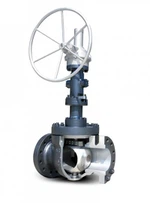


Soft Sealing Ball Valve
The soft sealing ball valve is actually the ball valve with soft seat(seat insert). Whatever it is floating ball valve, trunnion ball valve, DBB ball valve, platinum valve design team will recommend the most suitable seat insert based on the working condition( temperature & pressure). The common inserts used as sealing component are PTFE, PACKING PTFE, RPTFE, DEVLON, NYLON, PEEK, etc. Once the temperature is out of 350°C, our team will suggest our clients to apply metal-to-metal seat structure, design of which have strong extremely temperature durability and can keep high sealing performance under extremely working condition. For soft seated ball valve,the structure of it will be integral, split, 3-piece body. The length of ball valve that our team will try to meet your pipe line requirements. PMV soft sealing ball valve is widely applied in oil extraction or transportation of natural gas industry.
VALVE DESIGN
Based on API 6D
TEMPERATURE RANGE
-150 to 662°F (-101 to 350°C)
SIZE
NPS 1/2-6 (DN 15-150)
PRESSURE RATING
ASME 150 - ASME 2500
FACE-TO-FACE
As per API 6D standard
END CONNECTIONS
RF, RTJ as per B16.5 &B16.47
SW, Socket Welded as per B16.11
BODY DESIGN
Forged/casting bolted two-piece
SEAT DESIGN
Soft seated with Hardfacing on ball and seats
FEATURES
Secondary seals in pure Graphite
Anti-Static Device
Anti Blow out stem
Bi-directional tight shut-off
Low fugitive emission stem packing available
O-ring /Lip seals and Graphite configuration
OPERATOR
Manual: wrench or Gear with padlocking
TESTING & CERTIFICATIONS
Compliance with API 6D & ISO 5208 & API 598 inspection and testing
Fire safe and fire tested as per API 6FA/ 607
SIL 3 Certification as per IEC61508
Fugitive Emission as per ISO15848
PED 2014/68/UE
Why is a floating ball valve called "floating"?
Floating ball valve is more often used in middle temperature and pressure environment and the size is designed equal or less than 6 inches. Compared with trunnion ball valve, the sealing performance of the floating ball valve is just seat insert and other soft sealing material. The structure of trunnion ball valve is operating more stable with lower stem. The trunnion ball valve apply double sealing system matched with seat ring which can achieve excellent sealing performance.
Here's how the floating mechanism works:
No trunnion Axis: Unlike a trunnion ball valve, the ball in a floating ball valve is not mounted on a trunnion axis. This allows the ball to move slightly within the valve body as it responds to the pressure of the fluid flowing through it.
Pressure-Assisted Sealing: When the valve is closed, the fluid pressure pushes the ball against the downstream seat, creating a seal. This pressure-assisted sealing helps ensure a tight closure and reduces the need for high torque to close the valve.
Floating Action: As the valve is opened or closed, the ball "floats" between the inlet and outlet seats. The ball rotates on its own axis as it moves, allowing fluid to flow through the valve or blocking it completely.
Seating Adjustment: The floating design also allows for slight adjustment of the ball within the valve body. This can help compensate for wear on the seats or any slight misalignment, maintaining a good seal over time.
So in summary, the term "floating" refers to the ability of the ball to move slightly within the valve body as it responds to fluid pressure and rotates to control flow, rather than being trunnion in position.
FAQ
Q: How to select materials of seat insert?
A: In common condition, we will quote as your material requirements. If the seat insert our clients select is not suitable for your working condition(medium, temperature, pressure), we help you to change the suitable one for you. The working medium will directly touch with seat insert and working temperature and pressure will impact the sealing performance of seat insert, so our technical team will choose the most fittable material of seat insert for you based on it working condition. Below 150#, PTFE. 150# to 600# RPTFE. 600# to 900# Delvon. 900# to 1500# Devlon or Nylon. 2500# PEEK.
Q: What is API 6D?
A: API 6D is an international standard formulated by the American Petroleum Institute (API) specifically for valves used in pipeline systems of the oil and gas industry. The standard indicate the comprehensive requirements in the aspects of design, production, inspection, test, which provide the important reference for guarantee of quality and safety of valves.
Hot Tags: soft sealing ball valve, China soft sealing ball valve manufacturers, suppliers, forged steel floating ball valve, marine floating ball valve, cast steel floating ball valve, 2 piece floating ball valve, rtj ball valve, api 608 ball valve
Previous
Floating Ball ValveYou Might Also Like


Send Inquiry