


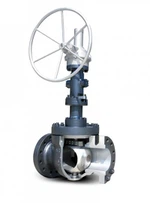


API 6D Floating Ball Valve
API 6D floating ball valves are manufactured in accordance with API 6D. The valve is configured in a forged bolted two-piece split-body design with a small diameter, suitable for medium/low pressure working conditions. Characterized by simple design, the valve seats are directly inserted into the body.
The upstream flow pressure pushes the free-floating ball against the downstream seat-the resulting compression provides a perfect leak-free sealing solution.
The stem is connected at the top of the ball and allowing the valve to open and close with a quarter-turn movement.
Material selection is fully customizable to meet the customer's project specifications and several unique features are available offering an enhanced technical solution suitable for aggressive offshore environment and corrosive and abrasive fluids.
VALVE DESIGN
Based on API 6D
TEMPERATURE RANGE
-150 to 662°F (-101 to 350°C)
SIZE
NPS 1/2-6 (DN 15-150)
PRESSURE RATING
ASME 150 - ASME 2500
FACE-TO-FACE
As per API 6D standard
END CONNECTIONS
RF, RTJ as per B16.5 &B16.47
SW, Socket Welded as per B16.11
BODY DESIGN
Forged/casting bolted two-piece
SEAT DESIGN
Soft or metal seated with Hardfacing on ball and seats
FEATURES
Secondary seals in pure Graphite
Anti-Static Device
Anti Blow out stem
Bi-directional tight shut-off
Low fugitive emission stem packing available
O-ring /Lip seals and Graphite configuration
OPERATOR
Manual: wrench or Gear with padlocking
TESTING & CERTIFICATIONS
Compliance with API 6D & ISO 5208 & API 598 inspection and testing
Fire safe and fire tested as per API 6FA/ 607
SIL 3 Certification as per IEC61508
Fugitive Emission as per ISO15848
PED 2014/68/UE
How to repair floating ball valves when they fail?
When a floating ball valve fails, the repair process requires meticulousness and caution. Here are some clear steps and summaries for reference:
1. Fault diagnosis
· Check for leaks: First, observe whether the valve is leaking. Leaks may come from seals, between the valve body and the valve cover, or other joints.
· Check operation: Try to operate the valve to see if it can open and close normally. Pay attention to whether it is stuck or not operating smoothly.
· Observe the external condition: Check whether there is damage, corrosion or fouling on the outside of the valve.
2. Disassembly preparation
· Close the valve: Make sure the valve is completely closed and disconnect the pipe.
· Prepare tools: Prepare the required disassembly tools, such as wrenches, screwdrivers, sealants, etc.
· Safety protection: Wear appropriate protective equipment, such as gloves, goggles, etc., to ensure safety.
3. Disassembly and inspection
· Disassemble the valve: Follow the disassembly steps and disassemble the valve step by step. Be careful to save all the removed parts for subsequent reassembly.
· Check the seal: Check whether the seal (such as the seal ring) is worn, aged or damaged. Replace the seal with a new one if necessary.
· Check the ball and seat: Check if there is wear or scratches between the ball and the seat. Repair or replace if necessary.
· Check other parts: Check if the valve stem, valve core and other parts are damaged or worn.
4. Repair and Replacement
· Replace the seal: If the seal is damaged, replace it with a new one using a suitable sealant. Ensure that the seal is installed correctly and tightly.
· Repair or replace the ball and seat: If the ball and seat are worn or damaged, repair or replace them. When repairing, pay attention to maintaining the flatness and smoothness of the ball and seat.
· Replace other parts: If other parts are damaged, replace them with new ones in time.
5. Reassembly and Test
· Reassembly: Reassemble the valve step by step in the reverse order of disassembly. Ensure that all parts are installed correctly.
· Test the valve: Reconnect the pipeline and test the valve's operating performance and sealing performance. Ensure that the valve can open and close normally and there is no leakage.
6. Precautions
Avoid violent operation: During disassembly and maintenance, avoid using violent operation to avoid damaging the valve or parts.
Keep clean: During maintenance, keep the valve and parts clean to avoid impurities entering the inside of the valve.
Proper installation: When reassembling, make sure all parts are installed correctly and follow the installation instructions.
By following the above steps and precautions, the failure of the floating ball valve can be effectively repaired and its normal operation can be ensured. If necessary, it is recommended to seek help from professional maintenance personnel.
Hot Tags: api 6d floating ball valve, China api 6d floating ball valve manufacturers, suppliers, threaded ball valve, marine floating ball valve, emergency shutdown valve, cast steel floating ball valve, api 608 ball valve, extended bonnet ball valve
You Might Also Like


Send Inquiry