


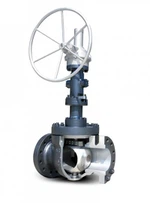

3 Piece Flange Floating Ball Valve
3 piece flange floating ball valves are manufactured in accordance with API 6D. The valve is configured in a forged bolted two-piece split-body design with a small diameter, suitable for medium/low pressure working conditions. Characterized by simple design, the valve seats are directly inserted into the body.
The upstream flow pressure pushes the free-floating ball against the downstream seat-the resulting compression provides a perfect leak-free sealing solution.
The stem is connected at the top of the ball and allowing the valve to open and close with a quarter-turn movement.
Material selection is fully customizable to meet the customer's project specifications and several unique features are available offering an enhanced technical solution suitable for aggressive offshore environment and corrosive and abrasive fluids.
VALVE DESIGN
Based on API 6D
TEMPERATURE RANGE
-150 to 662°F (-101 to 350°C)
SIZE
NPS 1/2-6 (DN 15-150)
PRESSURE RATING
ASME 150 - ASME 2500
FACE-TO-FACE
As per API 6D standard
END CONNECTIONS
FLANGE
BODY DESIGN
Forged/casting bolted two-piece
SEAT DESIGN
Soft or metal seated with Hardfacing on ball and seats
FEATURES
Secondary seals in pure Graphite
Anti-Static Device
Anti Blow out stem
Bi-directional tight shut-off
Low fugitive emission stem packing available
O-ring /Lip seals and Graphite configuration
OPERATOR
Manual: wrench or Gear with padlocking
TESTING & CERTIFICATIONS
Compliance with API 6D & ISO 5208 & API 598 inspection and testing
Fire safe and fire tested as per API 6FA/ 607
SIL 3 Certification as per IEC61508
Fugitive Emission as per ISO15848
PED 2014/68/UE
How to perform daily maintenance of floating ball valves?
For daily maintenance of floating ball valves, here are some recommended steps and precautions to ensure the normal operation of the valve and extend its service life:
Regular cleaning:
Clean the valve body, valve, bonnet and other parts regularly to ensure that the valve is unobstructed. The cleaning frequency can be determined according to the usage, but it is recommended to be done at least once a quarter.
When cleaning, the valve should be closed first and the valve body should be disassembled to remove internal sediments. After cleaning, reassemble and ensure that all parts are installed correctly.
Check the sealing performance:
The sealing performance is one of the key performances of the floating ball valve. Regularly check the sealing performance of the valve, including the sealing between the ball and the valve seat.
If leakage or poor sealing is found, the wear of the seals (such as the sealing ring) should be checked in time and replaced as needed.
Lubricate the moving parts:
Regularly lubricate the moving parts of the valve (such as the valve stem, ball, etc.) to reduce wear and friction.
Select a suitable lubricant and ensure that the lubricant is compatible with the working environment and media of the valve. The frequency of use of the lubricant can be determined according to actual conditions.
Replace parts:
If the float valve is found to have leakage, stuck valve or wear and other faults, the parts should be replaced in time.
When replacing parts, parts of the same specifications and models as the original parts should be selected to ensure the normal operation of the valve.
Pay attention to anti-corrosion:
Because the float valve is often in a harsh use environment, it is susceptible to corrosion. Therefore, anti-corrosion measures such as coating anti-corrosion coating or using anti-corrosion materials are required to protect the valve.
Observe the operating specifications:
When using the float valve, the operating specifications should be followed to avoid excessive opening or closing of the valve to avoid damage to the valve.
Pay attention to whether the medium contains solid particles, fibers or corrosive substances to avoid clogging or damage to the seal.
Record and monitor:
Record the maintenance history and use of the valve so that potential problems can be discovered in time and corresponding measures can be taken.
Use monitoring equipment (such as pressure gauges, thermometers, etc.) to monitor the operating status of the valve to ensure that it is in normal working condition.
By performing the above daily maintenance steps, the normal operation of the floating ball valve can be ensured and its service life can be extended. At the same time, these maintenance measures also help improve production efficiency and safety.
Hot Tags: 3 piece flange floating ball valve, China 3 piece flange floating ball valve manufacturers, suppliers, forged steel floating ball valve, api 608 ball valve, floating type ball valve, rtj ball valve, threaded ball valve, emergency shutdown valve
You Might Also Like


Send Inquiry