


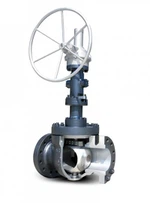

Thin Type Wafer Ball Valve
Thin Type Wafer Ball Valve
The Thin Type Wafer Ball Valve is designed for installation between mating pipe flanges, providing on-off flow control in piping systems with limited installation space. Its compact body configuration is suitable for OEM equipment, packaged process skids, and industrial utility lines. Material, pressure rating, seat, and actuation options should be selected according to the operating conditions and piping requirements.
Key Features & Design Highlights
Compact Wafer Construction
Short face-to-face dimensions help reduce axial installation space in compact piping layouts.
Quarter-Turn Operation
A 90° handle movement opens or closes the valve for straightforward on-off flow control.
Material and Seat Options
Stainless steel body options and different seat materials can be selected according to media compatibility, temperature, and pressure requirements.
Actuation Options
Manual, pneumatic, or electric operation may be available depending on the valve model and mounting configuration.
Technical Specifications
|
Parameter |
Available Options / Requirements |
|
Product Type |
Thin Type Wafer Ball Valve |
|
Nominal Size |
Confirm by model |
|
Pressure Rating |
Confirm the applicable PN or ASME Class rating |
|
Body Materials |
CF8, CF8M, CF3M, WCB; subject to model availability |
|
Ball & Stem Materials |
SS304, SS316, SS316L, or other specified materials |
|
Seat Materials |
PTFE, RTFE, PEEK, or other options subject to design |
|
Operating Temperature |
Confirm according to the complete valve configuration |
|
Operation |
Manual lever, gear operator, pneumatic, or electric, subject to model |
|
End Connection |
Wafer-style installation between compatible mating flanges |
|
Design & Testing Standards |
Confirm the standards applicable to the selected model and order |
Applications & Product Selection
OEM Equipment and Process Skids
For compact piping assemblies in packaged machinery and modular process systems.
Industrial Utility Lines
For compatible services such as water, cooling circuits, and compressed air within the valve's rated operating conditions.
General Process Isolation
For suitable industrial fluid-handling applications where quarter-turn shut-off is required.
Wafer Ball Valve vs. Conventional Flanged Ball Valve
|
Selection Factor |
Thin Type Wafer Ball Valve |
Conventional Flanged Ball Valve |
|
Installation Space |
Compact face-to-face configuration |
Depends on the valve's face-to-face dimensions |
|
Installation Method |
Installed between mating flanges |
Connected through integral end flanges |
|
Weight and Footprint |
May reduce valve weight and installation footprint |
Depends on size, body design, and pressure rating |
|
Actuation |
Depends on the mounting pad and model |
Depends on the valve and actuator configuration |
Quality Control & Documentation
Pressure Testing
Shell and seat tests should follow the specified applicable standard and agreed acceptance criteria.
Material Verification
Material identification and traceability documents can be specified according to project requirements and supply arrangements.
Inspection Records
Request applicable pressure-test reports, material certificates, dimensional inspection records, and conformity documents with the quotation.
Customization & RFQ Requirements
Size and Pressure Rating: DN/NPS, required pressure class, and design conditions.
Operating Conditions: Fluid medium, normal and maximum pressure, and minimum and maximum temperature.
Materials and Connections: Body, ball, stem, seat, and mating flange standard.
Operation and Documentation: Manual or automated operation, actuator requirements, applicable standards, and required inspection documents.
Frequently Asked Questions
Q: What is the main advantage of a thin type wafer ball valve?
A: Its compact face-to-face configuration can help reduce installation space in piping systems where axial clearance is limited.
Q: How can I confirm compatibility with existing pipe flanges?
A: Provide the flange standard, pressure class, nominal size, and relevant piping dimensions. Confirm compatibility against the approved valve drawings before installation.
Q: Which seat material should I select?
A: The choice depends on the fluid, operating temperature, pressure, and chemical compatibility. Confirm the complete valve's operating limits rather than selecting by seat material alone.
Q: Can the valve be fitted with a pneumatic or electric actuator?
A: Actuation may be available for compatible models. Confirm the mounting interface, operating torque, actuator specifications, and required accessories before ordering.
Q: What documents should I request with the order?
A: Depending on project requirements and availability, these may include material certificates, pressure-test reports, dimensional drawings, and conformity documentation. Specify required documents in the RFQ.
Hot Tags: thin type wafer ball valve, China thin type wafer ball valve manufacturers, suppliers
You Might Also Like
Send Inquiry