


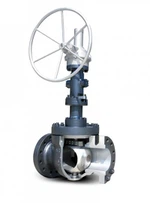

High Pressure Forged Steel Ball Valve
High Pressure Forged Steel Ball Valve
High pressure forged steel ball valves provide quarter-turn isolation for industrial piping systems. Selection depends on pressure-temperature ratings, process media, valve size, sealing requirements, materials, and end connections.
Product Overview
Forged Steel Body: Available in specified carbon steel, low-temperature steel, and stainless steel grades according to the selected valve configuration.
Quarter-Turn Operation: A 90-degree ball rotation opens or closes the flow passage for pipeline isolation.
Application-Specific Design: Floating or trunnion-mounted construction, seat materials, and operating methods are selected according to service conditions.
Ball Design & Sealing Options
Floating Ball Design: The ball moves under differential pressure to load the downstream seat. Suitability depends on valve size, pressure rating, and operating torque.
Trunnion-Mounted Design: Mechanical ball support can reduce pressure-induced operating torque, particularly in larger-bore and higher-pressure applications.
Soft & Metal Seats: PTFE, R-PTFE, and PEEK may suit compatible media and temperature ranges. Metal seats may be considered for specified abrasive, erosive, or high-temperature services.
Stem & Actuation: Stem retention, packing, anti-static features, and manual or automated operation are specified according to the valve design and project requirements.
Technical Specifications
|
Parameter |
Options / Requirements |
|
Valve Type |
Floating ball / Trunnion-mounted ball |
|
Nominal Size |
Confirm by valve design and pressure class |
|
Pressure Rating |
Applicable ASME Class or specified rating |
|
Body Materials |
ASTM A105, ASTM A350 LF2, ASTM A182 F316/F316L, subject to availability |
|
Ball & Stem Materials |
Carbon steel or stainless steel grades according to specification |
|
Seat Materials |
PTFE, R-PTFE, PEEK, Devlon, or specified metal seats |
|
End Connections |
Flanged RF/RTJ, socket weld, butt weld, or threaded, where available |
|
Design Standards |
API 6D, API 608, ASME B16.34, or ISO 17292, as applicable |
|
Inspection & Testing |
Applicable requirements under API 598, API 6D, or ISO 5208 |
|
Documentation |
Material certificates, inspection records, and test reports as specified |
Applications & Selection
Oil & Gas: Pipeline and process-line isolation, subject to the applicable pipeline specification and service conditions.
Refining & Petrochemical: Hydrocarbon isolation with materials and seals selected for the process medium.
Chemical Processing: Process-fluid isolation after evaluating corrosion resistance and seal compatibility.
High-Pressure Systems: Selection based on design pressure, temperature, differential pressure, and required shut-off performance.
Key Selection Factors
Operating Conditions: Specify the medium, design and operating pressures, and temperature range.
Flow Passage: Select full bore or reduced bore according to pipeline and flow requirements.
Sealing Requirements: Confirm seat material and the required leakage acceptance criteria.
Pipeline Interface: Specify nominal size, flange rating and facing, or welding-end dimensions.
Quality Control & Testing
Material Traceability: Specify heat-number traceability and material test certificates for applicable pressure-retaining components.
Dimensional Inspection & NDE: Inspection methods and acceptance criteria are defined by the applicable specification and inspection plan.
Pressure Testing: Shell and seat tests are conducted according to the agreed test standard and acceptance requirements.
Project Documentation: Material reports, pressure-test records, NDE reports, and third-party inspection documents can be defined in the purchase specification.
Customization & RFQ Requirements
For accurate technical evaluation and quotation, provide:
Valve Specifications: Quantity, nominal size, pressure class, bore type, and end connections.
Service Conditions: Medium composition, design and operating pressure, temperature, and differential pressure.
Materials & Operation: Body, ball, stem, seat, packing, and manual or actuator requirements.
Standards & Delivery: Applicable design and test standards, NDE scope, certification requirements, third-party inspection, delivery date, and destination.
Frequently Asked Questions
Q: How do I select the correct pressure class?
A: Confirm the design pressure, operating temperature, body material, and applicable design standard. Check the relevant pressure-temperature ratings before selecting the valve.
Q: What is the difference between floating and trunnion-mounted ball valves?
A: A floating ball moves against the downstream seat under differential pressure. A trunnion-mounted ball is mechanically supported, which can reduce operating torque in larger or higher-pressure designs.
Q: When should I choose metal seats instead of soft seats?
A: Soft seats may suit compatible media within their specified temperature limits. Metal seats may be appropriate for certain abrasive, erosive, or high-temperature services. Confirm the operating envelope and leakage requirements for the selected design.
Q: Are fire-safe and fugitive-emission qualifications standard?
A: Not necessarily. Specify the required standard, such as API 607 or API 6FA for applicable fire testing, or ISO 15848-1 for fugitive-emission qualification. Confirm the available qualification documents for the exact valve design.
Hot Tags: high pressure forged steel ball valve, China high pressure forged steel ball valve manufacturers, suppliers
You Might Also Like
Send Inquiry