


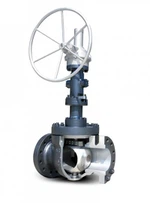

On-Off Motorized Ball Valve
On-Off Motorized Ball Valve
An On-Off Motorized Ball Valve combines a quarter-turn ball valve with an electric actuator to automate pipeline opening and closing. It is used in industrial systems where remote operation, electrical control, and defined open/closed positions are required.
Product Overview
Two-Position Control: Electrically operated opening and closing for automated pipeline isolation.
Quarter-Turn Operation: The ball rotates approximately 90 degrees between open and closed positions.
Multiple Valve Configurations: Two-way or three-way designs, subject to the available product range.
Electrical Integration: Compatible control and feedback arrangements can be selected for PLCs, relay circuits, and building management systems.
Application-Specific Materials: Valve body, ball, stem, and seat materials are selected according to the fluid, temperature, pressure, and chemical compatibility requirements.
Optional Control Functions: Open/closed position feedback, manual override, and fail-safe functions may be available depending on the actuator configuration.
Selection Note: Confirm the working pressure, maximum differential pressure, fluid composition, temperature range, required leakage class, electrical supply, and operating frequency before selecting the valve and actuator assembly.
Valve Design and Actuator Options
Valve Structure and Flow Control
The ball valve uses a rotating ball with a through-bore to control fluid passage. In the fully open position, the bore aligns with the pipeline. In the closed position, the ball blocks the flow path.
Available configurations may include:
Two-Way Ball Valve: For opening and closing a single pipeline flow path.
Three-Way Ball Valve: For flow switching or distribution, depending on the port arrangement and ball configuration.
Full-Port or Reduced-Port Design: Selected according to flow capacity, installation space, and system pressure-loss requirements.
Soft-Seated or Metal-Seated Construction: Selected according to media compatibility, operating temperature, differential pressure, and required seat leakage performance.
Actual flow capacity and leakage performance depend on the selected valve design and operating conditions.
Electric Actuator and Control
The electric actuator converts electrical power into the rotary movement required to operate the valve.
Available options may include:
AC or DC power supply, according to the selected actuator.
Open/close commands through compatible relay or PLC control circuits.
Auxiliary limit switches for open/closed position feedback.
Local position indication.
Manual override for applicable actuator models.
Fail-safe or backup-power functions where supported by the selected configuration.
Technical Specifications
The following table provides a preliminary selection framework. The stated ranges represent potential series-level options and must be verified against the applicable model and configuration before ordering.
|
Parameter |
Available Options / Selection Requirements |
|
Product Type |
On-Off Motorized Ball Valve |
|
Valve Configuration |
Two-way or three-way, subject to model availability |
|
Nominal Size |
DN15–DN300 (1/2"–12"), subject to model availability |
|
Pressure Rating |
PN10, PN16, PN25, PN40; ASME Class 150, 300, or 600 where applicable |
|
Valve Body Materials |
Stainless steel, including CF8/CF8M/CF3M; carbon steel WCB; brass or UPVC where available |
|
Ball and Stem Materials |
SS304, SS316, SS316L, subject to model and material specification |
|
Seat Materials |
PTFE, reinforced PTFE (R-PTFE), PEEK, or metal seat, where available |
|
End Connections |
Threaded NPT/BSP, flanged, socket weld, or sanitary clamp connections where supported |
|
Operating Temperature |
Determined by valve body, seat, packing, actuator, and service conditions |
|
Actuator Power Supply |
Options may include 12 VDC, 24 VDC, 24 VAC, 110 VAC, 220 VAC, or 380 VAC, subject to model availability |
|
Control Mode |
Electrical open/close control; interface depends on actuator configuration |
|
Operating Time |
Model-dependent; confirm the required opening and closing time |
|
Position Feedback |
Auxiliary limit switches or other available feedback options |
|
Enclosure Protection |
Confirm the actuator's rated IP or NEMA protection level |
|
Hazardous-Area Suitability |
Only applicable to actuators with the required verified hazardous-area certification |
|
Testing |
Specify the applicable shell and seat leakage test standard and acceptance criteria |
Important Technical Notes
Pressure ratings and allowable temperatures must be verified against the relevant pressure-temperature limits for the selected valve.
The maximum operating pressure of the complete assembly may be limited by the valve body, seat, connection, or other components.
Electrical voltage, frequency, wiring, and control inputs must match the selected actuator.
High-temperature, metal-seated, hazardous-area, and fail-safe configurations require separate technical confirmation.
API 598 or ISO 5208 testing should be specified according to the applicable valve design and required acceptance criteria.
Applications
Water Treatment and Filtration
Used for automated isolation in water distribution, filtration, reverse osmosis, and compatible chemical dosing systems. Body and seat materials must be selected according to the fluid composition and operating conditions.
HVAC and Building Automation
Used for open/close control of compatible chilled-water and hot-water circuits. Confirm the valve's flow capacity, pressure drop, temperature limits, and actuator control requirements.
Industrial Machinery and Equipment
Suitable for fluid isolation in compatible coolant circuits, filling equipment, and automated production systems where electrical valve operation is required.
OEM Equipment and Process Skids
Can be integrated into packaged equipment, industrial washing systems, and process skids when the valve dimensions, electrical interface, connection type, and operating parameters match the equipment design.
Chemical and General Process Piping
Used for on-off control of compatible process fluids. Chemical compatibility must be assessed for the complete wetted assembly, including the body, ball, stem, seats, seals, and packing.
Materials, Configuration and Customization
Correct configuration selection helps prevent material incompatibility, actuator undersizing, and installation problems.
Valve Materials
Stainless Steel: CF8, CF8M, CF3M, SS304, SS316, or SS316L options, depending on component and model.
Carbon Steel: WCB body options for applicable industrial service conditions.
Brass or UPVC: Available only where supported by the product range and suitable for the specified media, pressure, and temperature.
Sealing Materials
PTFE: Commonly selected for compatible fluids and general industrial applications.
R-PTFE: Considered where reinforced seat material is appropriate for the required service conditions.
PEEK: An option for applications requiring a different combination of temperature, mechanical, and chemical properties.
Metal Seat: Considered for specified service conditions where a soft seat may not be suitable. The required leakage acceptance level must be confirmed.
Actuator Configuration
Specify the required supply voltage, control circuit, opening and closing time, position feedback, enclosure protection, manual override, and any fail-safe requirements.
For hazardous locations, provide the applicable area classification and required certification so the correct actuator can be evaluated.
Quality Control and Technical Documentation
Material Verification: Material certificates and, where specified, positive material identification (PMI).
Dimensional Inspection: Verification of critical dimensions against approved drawings and applicable interface requirements.
Pressure Testing: Shell and seat leakage testing according to the agreed standard and acceptance criteria.
Actuator Function Testing: Verification of opening and closing operation, limit-switch settings, and available position feedback.
Documentation: Applicable material certificates, pressure-test reports, wiring diagrams, operation manuals, and certificates of conformity where available and relevant.
Potential reference standards include API 598, ISO 5208, and applicable material or dimensional standards. The actual standards, inspection scope, and document package must be confirmed for each order.
ISO 9001, CE, RoHS, and other compliance claims should be stated only where supported by valid documentation applicable to the relevant factory, product, or component.
How to Select the Right On-Off Motorized Ball Valve
Fluid and Material Compatibility
Identify the fluid, concentration, contaminants, and any relevant chemical properties. Confirm the suitability of all wetted components.
Pressure and Temperature
Provide normal and maximum working pressure, maximum differential pressure across the closed valve, and minimum and maximum operating temperatures.
Valve Size and Flow Requirements
Specify the nominal pipe size, connection standard, required flow capacity, and whether a full-port or reduced-port design is acceptable.
Actuator Sizing
Confirm the supply voltage, required switching time, operating frequency, control method, and position feedback requirements. Actuator torque must be checked against the selected valve and operating conditions.
Installation and Environmental Conditions
Specify indoor or outdoor installation, ambient temperature, exposure to moisture or corrosive environments, and any hazardous-area classification.
Leakage and Testing Requirements
State the required seat leakage acceptance level, applicable test standard, and any project-specific inspection or documentation requirements.
Request for Quotation (RFQ)
For a more accurate technical evaluation and quotation, include the following information in your inquiry.
Required Product Information
Valve type: two-way or three-way.
Nominal size: DN or NPS.
Pressure rating: PN or ASME Class.
Body, ball, stem, and seat materials.
End connection type and applicable standard.
Required quantity.
Operating Conditions
Fluid name and concentration.
Normal and maximum working pressure.
Maximum differential pressure.
Minimum and maximum operating temperature.
Required leakage acceptance level.
Operating frequency and expected duty cycle.
Actuator Requirements
Power supply voltage and frequency.
Open/close control method.
Required operating time.
Position feedback requirements.
Manual override or fail-safe requirements.
Environmental protection rating and hazardous-area classification, if applicable.
Project and Delivery Requirements
Technical drawings or existing valve model references.
Applicable standards and inspection requirements.
Required certificates and documentation.
Delivery destination and target delivery date.
Providing these details helps establish whether the proposed valve and actuator configuration is suitable for the intended application.
Frequently Asked Questions
Q: What is the difference between an on-off motorized ball valve and a modulating electric ball valve?
A: An on-off motorized ball valve is intended primarily for fully open or fully closed operation. A modulating electric ball valve accepts a compatible proportional control signal, such as 4–20 mA or 0–10 V, to position the ball at intermediate angles. Confirm the control capability of the selected actuator before ordering.
Q: Can an on-off motorized ball valve be connected to a PLC or BMS?
A: Yes, provided the selected actuator's electrical interface is compatible with the control system. Relay-based commands and auxiliary position feedback are common options. Check the wiring diagram, input requirements, output contact ratings, and supply voltage before integration.
Q: How should the electric actuator be sized?
A: Actuator sizing should be based on the valve's required operating torque under the specified differential pressure and service conditions. The calculation should also consider temperature, seat material, operating frequency, and the actuator manufacturer's recommended sizing margin.
Q: Which seat material is suitable for my application?
A: PTFE, R-PTFE, PEEK, and metal seats have different operating limits and performance characteristics. Selection depends on fluid compatibility, temperature, pressure, required leakage acceptance, and operating conditions. Provide the process data for a suitable material recommendation.
Q: What happens if the power supply fails?
A: A standard electric actuator may remain in its last position when power is lost. Automatic movement to a preset open or closed position requires a suitable fail-safe or backup-power configuration. Confirm the required failure response and the availability of a compatible actuator before ordering.
Request Technical Information and a Quotation
Provide your valve size, pressure rating, fluid conditions, connection type, and actuator requirements to begin the selection process.
Available technical documents may include product datasheets, dimensional drawings, wiring diagrams, and inspection records, depending on the selected model and order requirements.
Request a Quote - Submit your operating conditions and quantity requirements.
Request a Datasheet - Confirm available models, dimensions, and technical specifications.
Discuss Your Application - Provide your process and control requirements for technical evaluation.
Hot Tags: on-off motorized ball valve, China on-off motorized ball valve manufacturers, suppliers
You Might Also Like
Send Inquiry