


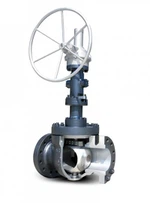


Threaded Ball Valve
Threaded floating ball valves are manufactured in accordance with API 6D. The valve is configured in a forged bolted two-piece split-body design with a small diameter, suitable for medium/low pressure working conditions. Characterized by simple design, the valve seats are directly inserted into the body.
The upstream flow pressure pushes the free-floating ball against the downstream seat-the resulting compression provides a perfect leak-free sealing solution.
The stem is connected at the top of the ball and allowing the valve to open and close with a quarter-turn movement.
Material selection is fully customizable to meet the customer's project specifications and several unique features are available offering an enhanced technical solution suitable for aggressive offshore environment and corrosive and abrasive fluids.
VALVE DESIGN
Based on API 6D
TEMPERATURE RANGE
-150 to 662°F (-101 to 350°C)
SIZE
NPS 1/2-6 (DN 15-150)
PRESSURE RATING
ASME 150 - ASME 2500
FACE-TO-FACE
As per API 6D standard
END CONNECTIONS
RF, RTJ as per B16.5 &B16.47
SW, Socket Welded as per B16.11
BODY DESIGN
Forged/casting bolted two-piece
SEAT DESIGN
Soft or metal seated with Hardfacing on ball and seats
FEATURES
Secondary seals in pure Graphite
Anti-Static Device
Anti Blow out stem
Bi-directional tight shut-off
Low fugitive emission stem packing available
O-ring /Lip seals and Graphite configuration
OPERATOR
Manual: wrench or Gear with padlocking
TESTING & CERTIFICATIONS
Compliance with API 6D & ISO 5208 & API 598 inspection and testing
Fire safe and fire tested as per API 6FA/ 607
SIL 3 Certification as per IEC61508
Fugitive Emission as per ISO15848
PED 2014/68/UE
What are the common faults of floating ball valves?
Common faults of floating ball valves mainly include the following aspects:
1. Blockage problem
Reason: impurities and garbage in the pipeline enter the floating ball valve, or the sealing gasket inside the valve is aged or deformed.
Solution: Close the valve and clean the impurities and garbage in the pipeline; use professional pipeline cleaning agent for cleaning; check whether the sealing gasket is aged and deformed, and replace it in time if there is a problem.
2. Water leakage problem
Reason: internal parts of the floating ball valve are damaged, poor sealing, etc.
Solution: Stop using the valve, check whether the internal parts are damaged, and replace them in time if there is a problem; check whether the sealing gasket is correctly installed or damaged, and replace the sealing gasket in time if there is a problem.
3. Damage to the floating ball
Reason: friction wear, impact deformation, etc.
Solution: Replace the new floating ball for repair.
4. Poor valve core sealing
Reason: aging of sealing materials, dust and impurities, etc.
Solution: Clean and replace the valve core and sealing materials.
5. Blockage of the inlet pipe
Reason: sediment and impurities accumulated in the pipeline, etc.
Solution: Clean the pipes, replace the inlet filter, etc.
6. Control problem
When the water level reaches the set height, the main valve still enters the water: it may be that there is no pressure in the control water chamber. Check whether the float valve can be closed, whether the main valve diaphragm is damaged, whether the needle valve is blocked, or whether the pipeline in front of the needle valve is unobstructed.
The pool liquid level is very low, and the main valve cannot open the water supply: check whether there are other valves in the main pipeline that are closed, whether the pipeline pressure is normal, whether the water output of the float valve is normal, the state of the ball valve, and whether the pipeline from the ball valve to the float valve is unobstructed.
7. Operation problem
Valve stuck: Long-term non-operation or poor operation may cause the valve to get stuck. First check whether the valve is blocked by foreign matter or dirt. If so, remove the foreign matter or dirt. If the valve is stuck due to stem deflection, sealing surface wear, etc., it is necessary to repair or replace parts.
8. Leakage problem
Reason: aging of the gasket, damage to the seal (such as O-rings, packing, etc.), deformation of the ball, etc.
Solution: According to the specific reasons, take measures such as replacing the gasket, replacing the seal, replacing the ball, etc. to eliminate them.
In short, understanding and identifying these common faults and taking corresponding solutions can effectively ensure the normal operation and service life of the floating ball valve.
Hot Tags: threaded ball valve, China threaded ball valve manufacturers, suppliers, 2 piece floating ball valve, api 608 ball valve, emergency shutdown valve, forged steel floating ball valve, stainless steel floating ball valve, threaded ball valve
Previous
Butt Weld Ball ValveYou Might Also Like


Send Inquiry